What Does a Small Craft Advisory Mean?
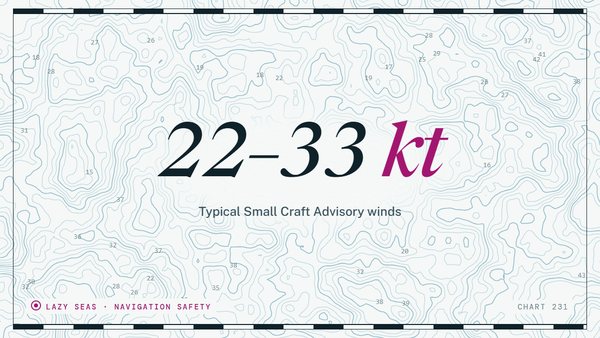
A Small Craft Advisory is a National Weather Service alert that winds or seas are strong enough to be hazardous to small boats. The exact trigger varies by region, but on most coasts it starts with sustained winds or frequent gusts somewhere in the low 20s up to 33 knots, or seas of roughly 5 to 7 feet or more. It is not a ban on going out. It is a clear signal that smaller boats and less experienced crews should stay in port.
On this page
A Small Craft Advisory is one of the most common marine alerts in the United States, and one of the most often ignored. It sounds mild next to a gale or storm warning, but for a bay boat, a kayak or a small sailboat, advisory conditions are where most trouble starts.
What Triggers a Small Craft Advisory
Advisories are issued by the local National Weather Service forecast office for its own coastal and lake waters, so the thresholds are not identical everywhere. Broadly, an advisory is issued for one or more of the following:
- Wind: sustained winds or frequent gusts from the low 20s up to 33 knots. In many areas the threshold is 25 knots; in some sheltered waters such as bays and sounds it is lower, around 20 knots.
- Seas: wave heights of roughly 5 to 7 feet or more, depending on the area. On exposed coasts the threshold is higher than in protected waters.
You may also see more specific versions: a Small Craft Advisory for Hazardous Seas, when the waves are the problem but the wind is not; a Small Craft Advisory for Winds; and a Small Craft Advisory for Rough Bar, issued where waves break across a harbor entrance or river bar. Some offices also issue a lower-level "exercise caution" statement when conditions are approaching advisory levels.
Where It Sits Among Marine Warnings
If the wind keeps rising, the advisory is replaced by stronger warnings:
| Alert | Sustained winds or frequent gusts |
|---|---|
| Small Craft Advisory | About 20 to 33 knots, set locally |
| Gale Warning | 34 to 47 knots |
| Storm Warning | 48 to 63 knots |
| Hurricane Force Wind Warning | 64 knots or more, outside of tropical storms |
Tropical storms and hurricanes have their own watches and warnings, which take over when one is approaching.
What Counts as a Small Craft?
There is no official size limit. The weather service's own guidance is that any vessel that could be adversely affected by advisory conditions should consider itself a small craft. In practice, that covers most recreational boats: kayaks, canoes, paddleboards, personal watercraft, small sailboats and powerboats up to around 30 feet. A larger boat with an inexperienced crew can be just as much at risk as a small one.
Is It Illegal to Go Out?
No. For recreational boaters in the United States, a Small Craft Advisory is advice, not a closure. The main exception is harbor bars: when conditions are dangerous, the Coast Guard can restrict or close bar crossings, particularly on the Pacific Northwest coast. Charter captains and rental businesses also often have their own rules and will cancel trips during an advisory.
Being legal is not the same as being sensible. Advisory winds build steep, short-period waves, the kind described in wave period explained, and those are hardest on small hulls.
What About the Red Flags?
For decades, a single red pennant flown at marinas and Coast Guard stations signaled a Small Craft Advisory, with two red pennants for a gale. The National Weather Service ended its official flag program in 1989, so today the forecast itself is the real source. Some marinas and yacht clubs still fly the flags as a courtesy, and they are worth heeding when you see them.
What to Do When One Is Issued
- Check the details, not just the headline. Read the timing, the wind speed and the wave heights for your zone. An advisory that starts at 3 in the afternoon may leave a good morning window.
- Compare it with your boat. Use the size guide in what wave height is considered rough water. If advisory conditions are beyond your boat's comfortable range, stay in.
- Paddlers should stay in. For kayaks and paddleboards, advisory winds are well past a sensible limit. See is it safe to kayak in 2 to 3 foot waves.
- If you are already out, head for shelter early rather than waiting to see how bad it gets. Our guide to staying safe during a storm at sea covers what to do if conditions catch you on the water.
Where to Check for Advisories
The National Weather Service publishes coastal marine forecasts and active advisories for every zone at weather.gov, and they are broadcast continuously on NOAA Weather Radio and VHF weather channels. Most marine forecast apps show the same alerts. Check the evening before a trip and again before you leave the dock: advisories are often issued or extended overnight.