What Is a Gale Warning? (34 to 47 Knots)

A Gale Warning is a National Weather Service marine warning for sustained winds or frequent gusts of 34 to 47 knots (39 to 54 mph) that are occurring or expected soon. It sits one step above a Small Craft Advisory and one step below a Storm Warning. For small recreational boats, it means stay in port.
On this page
You check the marine forecast the night before a trip and see "Gale Warning" at the top of your zone. It sounds old-fashioned, like something from a sailing novel, but it is a precise, modern warning with a number behind it. That number is 34 knots.
Here is what triggers a gale warning, how it fits with the other marine alerts, and what the sea actually does at those wind speeds.
What Wind Speed Is a Gale?
The National Weather Service issues a Gale Warning when sustained winds or frequent gusts of 34 to 47 knots are happening or expected. In land terms that is 39 to 54 mph, strong enough to snap small branches and make walking against it hard.
The number comes from the Beaufort wind scale, where force 8 is a "gale" (34 to 40 knots) and force 9 a "strong gale" (41 to 47 knots). For how wave heights map onto the official sea-state scale, see what wave height is considered rough water.
Gale Warning vs Small Craft Advisory
A Small Craft Advisory comes first. Its trigger varies by region, but in most coastal zones it starts somewhere around 22 to 33 knots, or at a set wave height. Our post on what a Small Craft Advisory means explains how each region sets it.
A Gale Warning is the next step up, and the difference is not small. Wind force grows with the square of wind speed, so a 35-knot wind pushes on a boat about two and a half times harder than a 22-knot wind.
The Full Ladder of Marine Wind Warnings
| Alert | Wind (knots) | Wind (mph) |
|---|---|---|
| Small Craft Advisory | About 22 to 33 (varies by region) | About 25 to 38 |
| Gale Warning | 34 to 47 | 39 to 54 |
| Storm Warning | 48 to 63 | 55 to 73 |
| Hurricane Force Wind Warning | 64 or more | 74 or more |
The storm and hurricane-force warnings in this table are for strong non-tropical systems, such as winter lows. When a hurricane or tropical storm is involved, the National Hurricane Center's tropical warnings take over.
The Weather Service can also issue a Gale Watch a day or two ahead, when gale-force winds are possible but not yet certain. Separately, a Special Marine Warning covers short bursts of 34 knots or more from thunderstorms, usually lasting under two hours.
What the Sea Does in a Gale
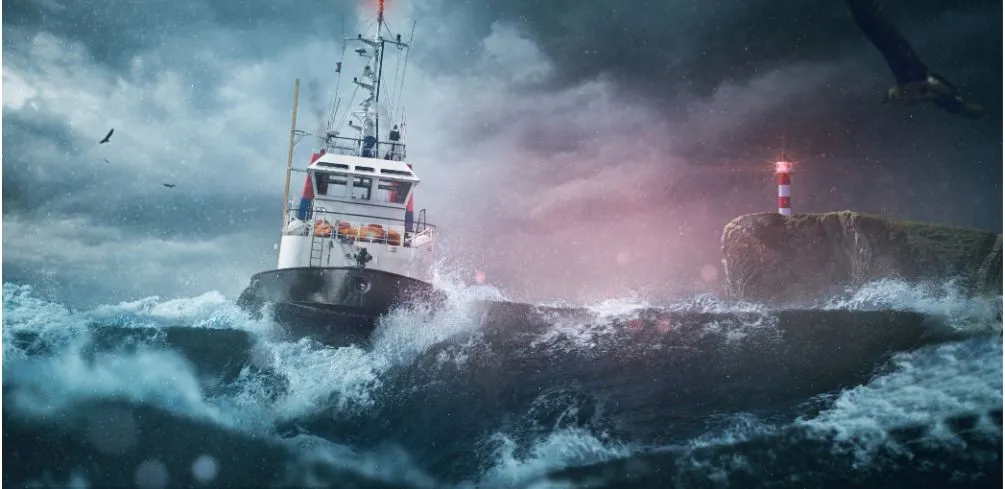
On the open ocean, with wind blowing over hundreds of miles for many hours, the Beaufort scale gives a probable wave height of about 18 feet at force 8. The crests break into spray, and the wind blows foam into long streaks across the water.
Closer to shore, waves are usually smaller because the wind has less open water to work with. They are also steeper and closer together, which is often worse for a small boat than height alone. Our guide to wave period explains why short, steep waves hit so hard.
Gales on the Great Lakes
Gale warnings are not just an ocean thing. The Weather Service issues them for the Great Lakes too, and November is the lakes' worst month, when strong autumn lows cross the region.
The best-known example is the freighter Edmund Fitzgerald, which sank in Lake Superior on November 10, 1975, during a November storm with waves reported as high as 25 feet. Lake waves are shorter and steeper than ocean swell of the same height, so a gale on a big lake can be as rough as one at sea.
What Should You Do When a Gale Warning Is Issued?
For recreational boats, a gale warning means stay in port. Even boats that handle a Small Craft Advisory day comfortably are out of their range at 34 knots, and gusts on the leading edge of a front can run higher than the forecast average.
If you are already out when one is issued, head for the nearest safe harbor early, while you still have a choice of routes. Our guide to staying safe during a storm at sea covers what to do if you can't get in.
At the dock, a gale is a reason to double your lines, add chafe protection and check fenders. Boats on moorings need a mooring rated for the wind, and a dinghy left in the water can flip.
Where Do You Find Gale Warnings?
The National Weather Service posts active warnings for every coastal zone at weather.gov, in the coastal waters forecast for your area. They are also broadcast continuously on NOAA Weather Radio and the VHF weather channels.
The old marina flags are gone as an official signal. The Weather Service ended its coastal flag program in 1989, so a missing pennant at the harbor tells you nothing about the forecast.
A gale warning is one of the clearest calls in marine weather: 34 knots and up, stay in. You can always go boating on a different day.